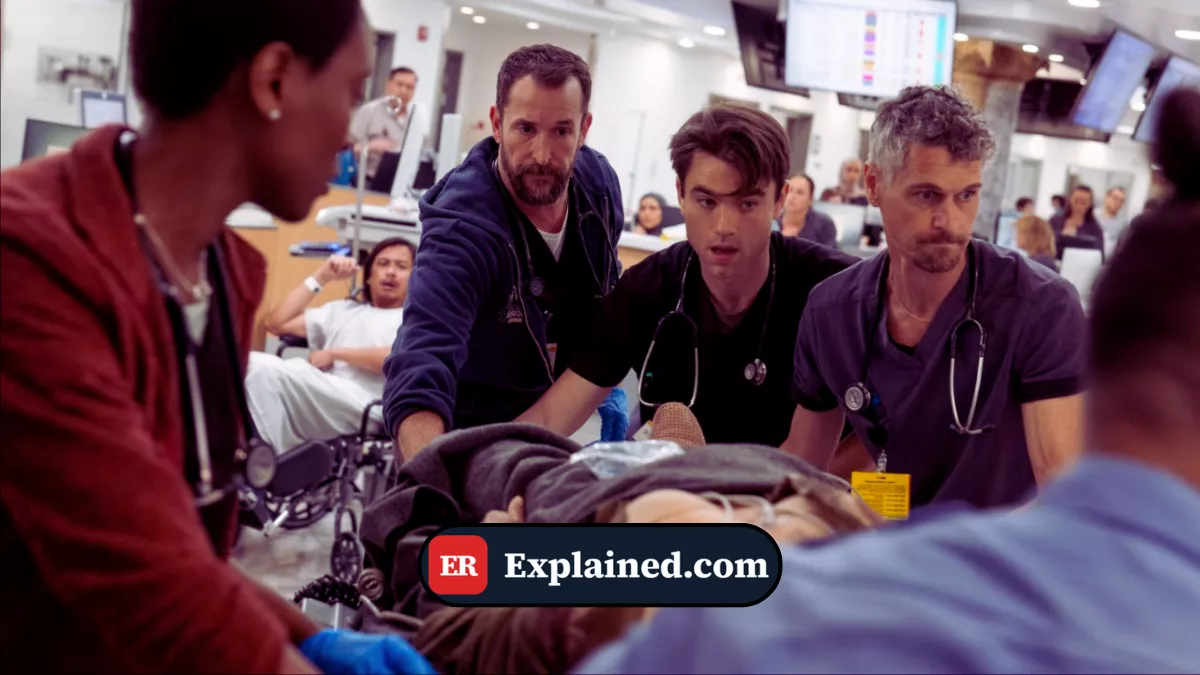
The Pitt — Episode 1-01, trauma room:
Mel places the ultrasound probe on Sam Wallace's abdomen, searching for the "Morrison's pouch." Dr. Samira instructs: "Look for any fluid collection." Mel quickly sweeps the probe, examining the space between kidney and liver. After 30 seconds: "No blood in Morrison's." Dr. Samira notes: "Good sign. That means he's not bleeding internally in the abdomen." The EFAST was complete in less than 3 minutes.
What is EFAST?
EFAST stands for "Extended Focused Assessment with Sonography for Trauma" — a rapid bedside ultrasound evaluation for trauma patients. Unlike a complete abdominal ultrasound taking 20–30 minutes, EFAST takes only 2–3 minutes and answers one simple question: "Is there free blood here?" This speed is critical in trauma where every second counts.
As seen in Episode 1-01, Mel performed EFAST on Sam to rule out abdominal bleeding while he was being intubated for intracranial hemorrhage. The negative result ("Morrison's clear") meant priority was neurosurgery, not abdominal surgery.
The 4 EFAST Ultrasound Windows
EFAST consists of 4 specific ultrasound windows, each evaluating a different area:
1. Pericardial Window (RUQ): Probe placed at right costal margin in 4th intercostal space. Assesses space around the heart (pericardial sac). If fluid detected, indicates hemopericardium—blood around heart causing tamponade. Normal image shows heart with surrounding black space (normal fluid). Abnormal fluid appears as excessive black accumulation around right ventricle.
2. Morrison's Window (RLQ): The "Morrison's pouch"—space between right kidney and liver (hepatorenal recess). This is the most dependent point of abdominal cavity in supine position. By gravity, any free abdominal blood collects here first. Normal image shows kidney and liver separated by black space (normal peritoneal fluid). Free blood appears as abnormal black or gray accumulation in this space.
3. Splenic Window (LUQ): Probe at left costal margin, looking for space between spleen and left kidney. Detects potential splenic bleeding. Mirrors Morrison's window anatomy but on left side. Sensitivity for hemoperitoneum can increase if patient in Trendelenburg position.
4. Pelvic Window (Suprapubic): Probe placed above pubic symphysis, moving inferiorly toward bladder. Detects fluid in pelvis—where blood collects in pelvic trauma, pelvic organ rupture, or delayed splenic bleeding draining by gravity.
How Ultrasound Technology Works
Ultrasound uses high-frequency sound waves (3–10 MHz) that penetrate tissues and return echoes. The machine converts echoes into grayscale images. Normal tissues appear in gray tones. Blood or free fluid appears as "black" space (anechoic)—no returning echoes because blood is mostly water.
Normal Finding (Negative): Space between organs is minimal black or just gray, with organs well-defined. No abnormal fluid accumulation.
Abnormal Finding (Positive): Presence of free black fluid (or gray in clotted blood) in abnormal amounts in abdominal spaces. Indicates abdominal bleeding, organ perforation, or both—requires urgent intervention.
Sensitivity and Limitations of EFAST
EFAST sensitivity for detecting hemoperitoneum ranges 73–90% depending on blood volume present. Excellent for rapid detection of significant bleeding (>500 mL), but may miss small amounts. For hemodynamically unstable trauma patients, EFAST is superior because it takes minutes. For stable patients, abdominal CT is more sensitive and provides exact injury location.
Important Limitations: Obesity reduces image quality (lung air and adipose tissue block ultrasound). Very large patients may have difficulty obtaining adequate windows. Subcutaneous emphysema (air in soft tissues after thoracic trauma) degrades quality. Operator-dependency means poorly trained provider may miss pathology or generate false positives.
Clinical Indications and When to Use EFAST
EFAST is indicated in any hemodynamically unstable trauma patient: falls from height, high-speed motor vehicle collision, penetrating injury (gunshot/stab), abdominal crush, pelvic trauma with instability. Also useful in stable patients when CT unavailable or high suspicion for bleeding.
In Sam's case in Episode 1-01, EFAST was used while resuscitation was ongoing—allowing team to continue intubation and stabilization while simultaneously ruling out abdominal bleeding as cause of shock.
Clinical Interpretation and Prognosis
Positive EFAST (Blood Detected): Patient likely needs emergency surgery. If hemodynamically unstable → goes directly to OR for hemorrhage control. If hemodynamically stable → abdominal CT performed to exactly locate bleeding source before surgery.
Negative EFAST (No Blood): Significantly reduces probability of significant abdominal bleeding. Does not completely exclude (especially retroperitoneal bleeding), but changes management—allows focus on other shock causes or trauma (like Sam's intracranial hemorrhage).

Frequently Asked Questions
Q: Does EFAST replace abdominal CT?
A: No. EFAST is rapid screening tool to detect blood presence. CT provides exact anatomic details on location and severity. Unstable patients → EFAST + surgery. Stable patients → EFAST + CT.
Q: How much training is needed to perform EFAST?
A: Requires formal trauma ultrasound training, typically 8–12 hours instruction plus supervised practice. Emergency physicians, trauma surgeons, ICU nurses, and paramedics can be trained.
Q: If EFAST is negative, can I completely rule out abdominal bleeding?
A: Not completely. EFAST sensitivity is 73–90%. Patients with <500 mL blood may have negative EFAST. Retroperitoneal bleeding may also be missed. Always correlate with physical exam, vitals, and clinical suspicion.
Q: Can EFAST detect things other than blood?
A: Primarily no. EFAST is focused on detecting free fluid in body cavities. Can detect free air (pneumoperitoneum) in some cases. Does not assess specific organ injuries—requires detailed ultrasound or CT.
Conclusion
EFAST is revolutionary tool that transformed trauma management, allowing rapid screening for abdominal bleeding in minutes instead of hours. As demonstrated in Episode 1-01 of The Pitt, EFAST allows trauma team to focus on right priorities—in Sam's case, intracranial hemorrhage rather than chasing abdominal bleeding. Proper training in EFAST is essential component of competency in modern emergency and trauma medicine.
To learn more about trauma instruments and emergency ultrasound, explore our articles on emergency ultrasound, rapid trauma assessment, and hemoperitoneum.
Disclaimer
This content is for educational purposes only and does not replace formal EFAST training or professional medical advice. EFAST requires certified training. For emergencies in the United States, call 911.
References
- American College of Radiology - EFAST Protocol Guidelines
- UpToDate - EFAST in Trauma
- Journal of Trauma and Acute Care Surgery - EFAST Validation Studies
- Mayo Clinic - Trauma Ultrasound
- PubMed Central - Extended FAST Literature Review